• are worth reading in full if you find constitutional history and/or death penalty procedure really interesting (and these are great topics for final papers).

    The full McGautha can be found here; reading just the majority opinion authored by Justice Harlan (which is only 1/4 of the whole thing) is encouraged, but not required, for having extra fun throughout next week's discussion.

    The full Furman can be found here; reading the whole thing could take you the rest of the semester, and our handout seeks to provide strategic highlights from each of the nine(!) opinions.  As mentioned, I will ask you in class  which of the nine opinions you would be most likely to join, so you might want to consider skimming the full version of the one opinion you find most appealing from our casebook.

  • we have lots of notable Ohio death penalty news.  For starters, yesterday a Ohio judge officially imposed a sentence of death here in Columbus as reported in this local article.  Here are some details (with a few "whos" highlighted):

    Clifton Duckson doesn’t know if the man who murdered his daughter and granddaughter in the backyard of his Far East Side house will ever be executed.  It was enough for him to be in a Franklin County courtroom Wednesday when the judge imposed the death penalty.  “I just needed to hear the words,” he said after Common Pleas Judge Chris Brown followed a jury’s recommendation and sentenced Kristofer Garrett to death. “Whether he ever gets put to death, that’s not my concern.”

    Duckson encouraged the judge to follow the recommendation on behalf of his 4-year-old granddaughter, Kristina Duckson, and her 34-year-old mother, Nicole Duckson, who were fatally stabbed on Jan. 5, 2018.  “I ask for justice, not revenge,” he said. “I’m asking for what those 12 jurors agreed was justice — the maximum penalty that the law will allow for these horrific murders.”

    The jury convicted Garrett, 26, of aggravated murder charges on Aug. 6. Testimony showed that Garrett ambushed Nicole Duckson, his ex-girlfriend, and their daughter, stabbing them repeatedly in the snowy backyard of the Fleet Road home they shared with Nicole’s father.

    Eight days later, after weighing the aggravating circumstances of the crimes against mitigating factors presented by Garrett’s defense team, the jurors agreed that two of the aggravating circumstances in Kristina’s death — that she was under the age of 13 and that Garrett killed her to cover up Nicole’s murder — outweighed any mitigating factors and recommended the death sentence.

    The judge, who had the option of imposing a sentence of life in prison, said he reached the same conclusion as the jury, and thus was required by state law to impose the death penalty.

    It was the first time since 2003 that a Franklin County jury had recommended a death sentence.  The last death sentence in the county was imposed in 2012 by a three-judge panel for Caron Montgomery, who waived his right to a jury in the stabbing deaths of his girlfriend and her two children.

    “I think when children are victims of a terrible crime, I think juries are going to look at (the death penalty) and the court’s going to look at it,” Prosecutor Ron O’Brien said after the hearing when asked about the rarity of death sentences in Franklin County.

    And just today, a panel of local federal judges got in the "who" act when they upheld the constitutionality of the (somewhat unique) lethal injection protocol that has been adopted by Ohio corrections official.  The ruling in In re Ohio Execution Protocol Litigation, No. 19-3064 (6th Cir. Sept 11, 2019) (available here), unlike lots of other death penalty opinions, is pretty short and shows what appellate judges can do when so interested.  As I explain in a post on my main blog, the next big question in this setting is whether Ohio Gov DeWine will now be eager to move forward with executions that he stayed based on the (now rejected) findings by a lower federal court in this litigation:  After Sixth Circuit panel approves (resoundingly) Ohio's execution protocol, will state now seek to restart its machinery of death?

  • Though I have not been able to find online all of the sentencing submissions in the college scandal case, the fine folks at Deadline have posted here the nine-page "Government’s Supplemental Sentencing Memorandum Concerning Defendant Felicity Huffman." The whole document makes for a fine read, and these paragraph at the very end struck me as especially effective:

    Finally, other considerations also support the government’s proposed sentence of one month of incarceration.  In the context of this case, neither probation nor home confinement (in a large home in the Hollywood Hills with an infinity pool) would constitute meaningful punishment or deter others from committing similar crimes.  Nor is a fine alone sufficient to reflect the seriousness of the offense or to promote respect for the law.  Even a fine at the high end of the applicable Guidelines range would amount to little more than a rounding error for a defendant with a net worth measured in the tens of millions of dollars.  See, e.g., United States v. Zukerman, 897 F.3d 423, 431 (2d Cir. 2018) (“A fine can only be an effective deterrent if it is painful to pay, and whether a given dollar amount hurts to cough up depends upon the wealth of the person paying it.”), cert. denied 139 S. Ct. 1262 (2019).  Likewise, community service, especially for the famous, is hardly a punishment — which is why many non-felons gladly perform it in the absence of court orders.

    The government’s recommended sentence of incarceration for a term of one month is sufficient but not more than necessary to achieve the goals of sentencing.  It would provide just punishment for the offense, make clear that this was a real crime, causing real harm, and reinforce the vital principle that all are equally subject to the law regardless of wealth or position.

  • I had no idea during our discussion on Wednesday of federal sentencing ranges for child pornography offenses that there would be a high-profile arrest in our own neighborhood on state charges involving this behavior just the next day.  This local article, headlined "Ohio TV station's chief meteorologist charged with child pornography," provides these details (with some highlighted in bold):

    A meteorologist for an Ohio television station has been arrested and charged with pandering sexually oriented matter involving a minor.  Mike Davis, chief meteorologist for WBNS-TV in Columbus, Ohio, was booked into the Franklin County Jail on Thursday for the second-degree felony.

    The alleged offense occurred on Aug. 5, 2019, according to Franklin County Municipal Court Records.  The records allege that Davis knowingly advertised for sale or dissemination an image of a young girl participating or engaging in sexual activity, according to WCMH-TV.

    Franklin County Sheriff Dallas Baldwin said in a news conference that two weeks ago, the Internet Crimes Against Children (ICAC) task force received a tip that Davis had allegedly sent and received a “significant” amount of child pornography, the station reported. “This establishes a pattern of behavior.  One week ago that information was confirmed and more evidence was gathered,” Baldwin said.

    ICAC executed search warrants Thursday morning at multiple locations that included Davis’ home and the WBNS-TV studios, WCMH-TV reported. ICAC detectives arrested Davis at his home Thursday morning.

    “These are kids that are clearly being exploited for sexual appetite,” Chief Deputy Rick Minerd said.

    “There’s no question that it was him versus someone else living in that home?” a WCMH-TV reported asked Minerd. “Yes,” Minerd said.

    The Ohio Revised Code provision, § 2907.322 Pandering sexually oriented matter involving a minor or impaired person, which serves as the basis for the charge against Davis, sets forth a second-degree felony which means the the sentencing range under Ohio law is "an indefinite prison term with a stated minimum term selected by the court of two, three, four, five, six, seven, or eight years and a maximum term [that is "plus fifty per cent of that term"].  In other words, if convicted under Ohio law for only this single charge, Davis could get as low as 2-3 years in state prison or as high as 8-12 years in state prison.  If he were subject to multiple charges, which certainly seems possible given the report of a “significant” amount of child pornography, the sentencing possibilities could expand.

    And, as we discussed in class, there are complicated federal criminal statutes, particularly 18 U.S.C. § 2252 and 18 U.S.C. § 2252A, under which Davis might be charged in federal court for this conduct. (And the Supreme Court confirmed this past Term that a defendant can be charge in two distinct jurisdictions based on the same criminal conduct.)  This chapter of a lengthy US Sentencing Commission report on child porn offense provides (just some of) the statutory ranges for this conduct under federal law:

    Upon conviction of any [child porn] production offenses, an offender faces a mandatory minimum term of 15 years of imprisonment and a maximum of 30 years…  Advertising child pornography carries a mandatory minimum penalty of 15 years of imprisonment….

    The offenses of receipt (or solicitation), transportation (including mailing or shipping), distribution, and possession with the intent to distribute or sell child pornography each carry a mandatory minimum term of five years of imprisonment and a maximum term of 20 years…

    The current statutory range of imprisonment for possession is zero to ten years of imprisonment if an offender possessed child pornography depicting a minor 12 years of age or older who was not then prepubescent and zero to 20 years of imprisonment if an offender possessed child pornography depicting a prepubescent minor or a minor under 12 years of age.

    I am not concerned that you know all of these particulars, but I am eager for you to see (a) how complicated this can get, and (b) how consequential the decision to charge in state versus federal court can sometimes prove to be.  Last but not least, I am already eager to hear any early musings about an appropriate sentence for Mike Davis.
  • Though I did not get us all the way through our discussion of important mandatory minimum cases like McMillan and Haymond (we will wrap these up next week), I think we covered a lot of useful ground in our extended discussions of mandatory minimum sentencing in class today.  And, as a useful follow-up, everyone is encouraged to take a few minutes to check out at the data assembled by the US Sentencing Commission in this short "Quick Facts" document about mandatory minimum penalties applied in the federal system.  Here are just some of many interesting tidbits from the document:

    Of all cases carrying a mandatory minimum penalty:
    — 70.5% were drug trafficking;
    — 5.7% were child pornography;
    — 5.5% were fraud;
    — 5.4% were firearms;
    — 4.4% were sexual abuse.

    40.6% of offenders convicted of an offense carrying a mandatory minimum were relieved of the penalty because:
    — 18.9% received relief through the safety valve provision;
    — 16.3% provided the government with substantial assistance;
    — 5.4% received relief through both.

    The average sentence length was:
    — 139 months for those subject to the mandatory minimum;
    — 65 months for those receiving relief;
    — 26 months for offenders who were not convicted of an offense carrying a mandatory minimum.

  • As mentioned in our last class, we will start wrapping up our formal "who" unit by reviewing the latest, greatest Supreme Court sentencing case, United States v. Haymond, 139 S. Ct. 2369 (June 26, 2019).  You are welcome to read Haymond in any form, and the full SCOTUS slip opinion can be accessed at this link.

    For maximum appreciation and understanding, you should be sure to read McMillan and Blakely in our text before turning to Haymond.  I doubt we will get through all three of these cases on Wednesday after the long holiday break, but I might try.  (Students are highly encouraged to start any discussions of McMillan and Blakely and Haymond in the notes, if so inclined.)

    Thereafter, we will turn to an (all-too-quick) review of capital sentencing law, procedures and practices.  As the syllabus reveals, the readings for this unit (which will keep us busy through most of the rest of September) are to be provided via handouts.  Those handouts will be provided in hard-copy in class, but I wanted to provide links here to electronic copies:

    Chapter 3, Topic A: Regulation of Discretion in Capital Sentencing

    Electronic Chapter 9: Race, Gender, and Class in Sentencing

    I plan to cover the first 69 manuscript pages in the Chapter 3 materials linked here and the first 21 pages manuscript pages in the Chapter 9 materials linked here.  (Of course, you are always welcome to read more.)

  • IN the next few weeks, we will be spending a lot of time discussing in various ways "who" plays a significant role in the sentencing process.  We will start with some normative discussion of just who you think are the "whos" who should (and who should not) be the most significant players in the sentencing process.  But the day-to-day work of the best criminal lawyers often involve (1) being able to effectively identify descriptively "who" actually plays a major role, and then (2) figuring out how best to influence the decisions of that "who."  

    In other words, those with good "who" radar can often be the most effective sentencing lawyers.  So I will spend a lot of time in class encouraging you to identify important "whos" in important sentencing setting.  And you can start honing your "who" radar by checking out some recent pieces from my sentencing blog that highlight some notable "who" realities:

    Notable Washington Supreme Court discussion of recidivist LWOP sentences while rejecting challenge to use of young adult "first strikes" 

    Exploring how compassionate release after FIRST STEP might indirectly help with persistent federal clemency problems

    Sixth Circuit judge in separate opinion makes case for Eighth Amendment precluding execution of persons under 21 at time of murder 

    Lots of advice on federal prisons for AG Barr and the new leadership at the Bureau of Prisons

    Terrific review of localities that are "Addicted to Fines"

  • I am grateful for the 30 students who completed and submitted the class questionnaire, and I am eager to get completed surveys ASAP (in my faculty mailbox on the third floor or by email) from anyone who has not yet submitted the form. I will be eager to discuss the collective "results" in class, and I really appreciate all the thought that was evident in many answers.

    Our discussion Wednesday will focus particularly on how students ranked the various theories of punishment.  But I want to make sure that our theory discussion is informed by some doctrine. Specifically, as the question in the title of this post reveals, I would be eager to discuss with some particularity whether you think the text or spirit of the US Constitution (or the federal criminal code) favors or prioritizes any particular theory of punishment.

    Of course, there are lots of provisions of the federal criminal code, but 18 US Code § 3553(a) (which is reprinted in our casebook) seems most central to this discussion give its instructions to  federal judges about what they must consider at sentencing.  Some parts of 3553(a) speak to specific classic theories of punishment, but do any seem particularly favored or prioritized (or disfavored)?  What theory is served by instructions like the requirement to consider "the need to avoid unwarranted sentence disparities" among similar defendants?

    And, of course, there are lots of provisions of the US Constitution.  But I think these two can usefully get a conversation started:

    The Preamble:  "We the People of the United States, in Order to form a more perfect Union, establish Justice, insure domestic Tranquility, provide for the common defence, promote the general Welfare, and secure the Blessings of Liberty to ourselves and our Posterity, do ordain and establish this Constitution for the United States of America."

    Amendment VIII:  "Excessive bail shall not be required, nor excessive fines imposed, nor cruel and unusual punishments inflicted."

  • This blog got started over a dozen years ago (with the uninspired title of Death Penalty Course @ Moritz College of Law) in order to facilitate student engagement in a Spring 2007 course on the death penalty.  Because the blog proved successful during that semester, and because the students' hard work as reflected in the archives still generates web traffic and might still be of interest to current students, I have kept repeatedly building subsequent sentencing classes on this platform by rebooting this blog for each new course.  

    It is now summer 2019, I am excited again to be gearing up again to teach Sentencing Law at the Moritz College of Law.  And, ever the web-savvy dinosaur, I am again planning to use this blog to flag current events and cases to supplement our in-class readings and discussions.  Because I use this blog (rather than TWEN) as convenient place to post information about class activities and plans and assignments, students can and should be on the look out for class materials and announcements posted here.

    So, for example, here is a repeating of what is posted on the Moritz official website for our first assignments (along with electronic copies of the basic course documents):

    In preparation for our first week of classes starting Monday, August 19, 2019 you should:

    1.  Get a copy of the FOURTH edition of the casebook for the course, along with the course description/syllabus.

    2.  Access the questionnaire and fill it out before our first class.  (In addition to being posted below, the pre-class questionnaire and course description/syllabus are available in hard-copy in front of my office, Room 313.)

    3.  Find/research on your own a real sentencing issue, case or story that is of significant interest to you, and come to our first week of classes prepared to explain this issue, case or story and why it is of significant interest to you. 

    Download 2019 Sentencing Law pre-class survey

    Download 2019 Sentencing Law course description and syllabus

    You will discover that the last items in the pre-class questionnaire reference two real-world sentencing cases, and here are just a few links with some background on those cases:

    Felicity Huffman 

    Lee Boyd Malvo 

  • I received a cool call earlier this week from folks at Ohioans To Stop Executions.  They reported that they are helping to host on Tuesday, May 22 a delegation from the European Union.  Around lunchtime, this EU group wants to meet with "Professor Berman and some of his students" to talk about Ohio's administration of the death penalty.  (I believe I got this call in part because I served as a member of the Joint Task Force to Review the Administration of Ohio’s Death Penalty that issued 50+ recommendations via this April 2014 report.)

    I do not yet know any more details about this gathering, but I suspect more "who and where" details will be filled in shortly.  Any student who is available during the lunch hour of May 22 and interested in being part of this discussion/event should send me a note.

  • I have now finally double- and triple-checked my various files to confirm my records on how many mini-papers I believe I received from each student.  All 42 of you should be able to find you names on the spreadsheet uploaded here, and therein you will find an associated number for how many papers I have in hand from you.

    Download Mini paper submissions for Spring 2018

    If you see what you think is an error in my accounting, please let me know before the end of next week.

    Speaking of the end of next week, please remember that you need to submit a final paper or a final exam to complete the course, and that submission needs to be no later than May 10.  (I am fearful that the Registrar is unable to prevent the exam software from demanding that exam takers submit their take home answers by May 9.  I hope that does not prove to be a problem for anyone, and I should be around on May 10 in case of any potential hiccups.)

    I am continuing to enjoy re-reading your mini-papers and now reading some final drafts.  I try to provide some general feedback on drafts within a few days of receipt, but that opportunity will be extinguished in the next few days.  Feel free to email me with any questions. 

  • remember that if you are taking the take-home exam, you should upload your exam answers to http://www.exam4.com on or before May 10. (Remember that a copy of the exam can be downloaded at the same locale and can also be found in front of my office.)

    If you are working on a final paper, you should turn in that paper on or before May 10, and if you want feedback on a draft I would be grateful to see it at least a few days before then.

    And whatever your plans, be checking this space (and my main blog) for continued coverage of sentencing topics AND for continued opportunities to comment about sentencing topics to continue to earn class participation points.

  • As we finish up the semester with a final few classes examining the particulars of modern mass incarceration and possible alternatives, I realize it would be useful and fitting to return to some of the early themes of the class concerning the "why" and "who" of sentencing.  Specifically (and building off themes stressed by Fordham Law Professor John Pfaff at the Reckless-Dinitz Lecture), I will likely start Monday's class by exploring:

    (1) "why" incarceration has become such a popular punishment in modern American history, and

    (2) "who" has been most responsible for the particular emphasis on incarceration in modern American history.

    I think some reasonable answers to these questions are important for anyone eager to move the nation away from modern mass incarceration: without having some sense of just why incarceration has proved so popular and just who has had a leading role in inflating incarceration levels, it will be hard to engineer a successful change of course.

    Especially because there have recently been a whole lot of notable new court opinions about Eighth Amendment limits on extreme juvenile prison sentences — see examples here and here and here and here and here from the Third Circuit, the District of Connecticut, the Iowa Supreme Court, the Georgia Supreme Court and the Wyoming Supreme Court — I am especially eager to discuss what role we think courts have played in creating modern mass incarceration and what role courts could play in moving us away from modern mass incarceration.

    In this context (and again to serve as a kind of semester review), I think it important to recognize that courts have played a major role in the modern decline of the death penalty in the United States over the last two decades.  All sort of litigation has played all sorts of roles in "gumming up" the modern machinery of death, and many abolitionists have come to expect that the US Supreme Court will play a starring role in a final push to have the death penalty fully abolished throughout the United States. 

    Is there any basis to hope or expect courts to play a major role in a decline in the use of incarceration in the United States over the next two decades?

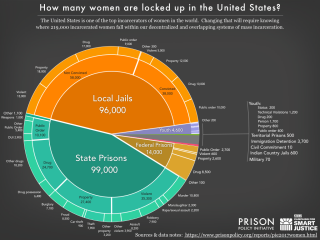
  • Women_pie_2017The question in the title of this post will be one I will be eager to unpack in coming classes, and it is inspired in part by the points emphasized in the Prison Policy Initiative updated version of its terrific incarceration "pie" graphic and report now at this link.  Here is part of the PPI pie report's introductory text and subsequent discussion:

    While this pie chart provides a comprehensive snapshot of our correctional system, the graphic does not capture the enormous churn in and out of our correctional facilities and the far larger universe of people whose lives are affected by the criminal justice system. Every year, 626,000 people walk out of prison gates, but people go to jail 10.6 million times each year. Jail churn is particularly high because most people in jails have not been convicted. Some have just been arrested and will make bail in the next few hours or days, and others are too poor to make bail and must remain behind bars until their trial. Only a small number (150,000 on any given day) have been convicted, generally serving misdemeanors sentences under a year….

    Breaking down incarceration by offense type also exposes some disturbing facts about the youth confined by our criminal and juvenile justice systems: Too many are there for a “most serious offense” that is not even a crime. For example, there are over 8,500 youth behind bars for “technical violations” of the requirements of their probation, rather than for a new offense. Further, 2,300 youth are locked up for “status” offenses, which are “behaviors that are not law violations for adults, such as running away, truancy, and incorrigibility.” Nearly 1 in 10 is held in an adult jail or prison, and most of the others are held in juvenile facilities that look and operate a lot like prisons and jails.

    Turning to the people who are locked up criminally and civilly for immigration-related issues, we find that 13,000 people are in federal prison for criminal convictions of violating federal immigration laws, and 13,000 more are held pretrial by U.S. Marshals. Another 34,000 are civilly detained by U.S. Immigration and Customs Enforcement (ICE) separate from any criminal proceedings and are physically confined in federally-run or privately-run immigration detention facilities or in local jails under contract with ICE. (Notably, these categories do not include immigrants represented in other pie slices because of non-immigration related criminal convictions.)

    Adding to the universe of people who are confined because of justice system involvement, 22,000 people are involuntarily detained or committed to state psychiatric hospitals and civil commitment centers. Many of these people are not even convicted, and some are held indefinitely. 9,000 are being evaluated pre-trial or treated for incompetency to stand trial; 6,000 have been found not guilty by reason of insanity or guilty but mentally ill; another 6,000 are people convicted of sexual crimes who are involuntarily committed after their prison sentences are complete. While these facilities aren’t typically run by departments of correction, they are in reality much like prisons….

    While this “whole pie” provides the most inclusive view of the various systems of confinement in the U.S. justice system available, these snapshots can’t capture all of the important systemic issues. Once we have wrapped our minds around the “whole pie” of mass incarceration, for example, we should zoom out and note that being locked up is just one piece of the larger pie of correctional control. There are another 840,000 people on parole and a staggering 3.7 million people on probation. Particularly given the often onerous conditions of probation, policymakers should be cautious of “alternatives to incarceration” that can easily widen the net of criminalization to people who are not a threat to public safety.

    Beyond identifying the parts of the criminal justice system that impact the most people, we should also focus on who is most impacted and who is left behind by policy change. For example, people of color are dramatically overrepresented in the nation’s prisons and jails. These racial disparities are particularly stark for Blacks, who make up 40% of the incarcerated population despite representing only 13% of U.S residents. Gender disparities matter too: rates of incarceration have grown even faster for women than for men. As policymakers continue to push for reforms that reduce incarceration, they should avoid changes that will widen disparities, as has happened with juvenile confinement and with women in state prisons.

    Notably, last fall the Prison Policy Initiative working jointly with the ACLU’s Campaign for Smart Justice released this great report with a particular population perspective: "Women’s Mass Incarceration: The Whole Pie 2017."  The report explains that it provides "a first-of-its-kind detailed view of the 219,000 women incarcerated in the United States, and how they fit into the even larger picture of correctional control."  In addition to thinking about how the female incarceration "pie" looks different, I wonder if you share my concern about discussion of "women's mass incarceration" given that there are around 165 million women in the United States and thus really less than 0.15% of all US women are incarcerated. 

    Is it accurate and helpful to describe a phenomenon as "mass" if it directly impacts less than 1 out of 500 persons in a population?

  • 9780465096916As repeatedly mentioned in class, Fordham Law Professor John Pfaff will be on campus this coming Thursday, April 12.  At 4pm at the Barrister Club he will be delivering the Reckless-Dinitz Lecture titled "Moving Past the Standard Story: Rethinking the Causes of Mass Incarceration." Here is the abstract for this lecture:

    "Reducing America's exceptional reliance on incarceration is one of the few issues of genuine bipartisan cooperation these days. Yet despite years of work, change has been slow and halting.  One critical reason is that the story we tell about what has driven prison growth often emphasizes causes that matter less at the expense of those that matter more.

    "We talk about the impact of long sentences — which certainly matter — but end up overlooking the even more important role of prosecutorial charging behavior in the process.  We emphasize the need to stop sending people to prison for drugs, but as a result fail to talk about changing how we punish those convicted of violence — even though only 15% of the prison population is serving time for drugs, compared to over 50% for violence.  And reformers frequently direct their attention on private prisons, and thus don't focus on the fact that public institutions hold over 90% of all inmates, and that (public) correctional officer unions and legislators with public prisons in their districts play far bigger roles than the private prison firms in pushing back against reform efforts. Even the modest reductions in prison populations since 2010 are something to celebrate, but more substantive cuts will require us to start asking tougher questions about the sorts of changes we need to demand."

    As I have noted before, Professor Pfaff is the author of Locked in: The True Causes of Mass Incarceration—and How to Achieve Real Reform (2017), and I expect his lecture will be covering many points he develops in his book.  Were I an evil lawprof, I could demannd that you all read his full book ASAP.  Instead, I will be content to here link to some effective reviews of Locked In:

    Though everyone should feel free to read Locked In, for class discussion purposes I think it might be useful for folks to read Professor Pfaff latest commentary titled "A Smarter Approach to Federal Assistance with State-Level Criminal Justice Reform."  Here is its abstract:

    This brief explains how Congress and the president can best help reduce our country’s outsized reliance on imprisonment, a goal with rare, widespread bipartisan support. Successful interventions will need to target issues that previous efforts have overlooked or ignored, and they will need to take better account of the haphazard ways that costs, benefits, and responsibilities are fractured across city, county, state, and federal governments. If designed properly, however, federal efforts could play an important role in pushing our criminal justice system to adopt more efficient, as well as more humane, approaches to managing and reducing crime.

  • On April 2, Zachary Bolitho, Moritz class of 2007 who now serves as Deputy Chief of Staff and Associate Deputy Attorney General to the Deputy Attorney General Rod Rosenstein, will be speaking to our class.  As mentioned in class, here is how he would like all of us to prepare for his visit:

    In terms of reading, it might be helpful if the students were familiar with Judge Pryor’s “presumptive guidelines” proposal (described in this speech to the American Law Institute).  I plan to spend a few minutes discussing how the Commission operates, what role DOJ plays in the process, what amendments are pending at the Commission now, and then I’d like to just have a discussion with the students.  I’d particularly love to hear their reactions to Judge Pryor’s proposal.

    If there are particular questions that you would like me to address (or topics you know the students will want to discuss), please send them my way.

  • As highlighted in previous posts,  on April 2, Zachary Bolitho, Moritz class of 2007 who now serves as Deputy Chief of Staff and Associate Deputy Attorney General to the Deputy Attorney General Rod Rosenstein, will be speaking to our class.  As repeatedly mentioned, and as shown at the end of this list of US Sentencing Commissioners, Zachary Bolitho also now serves as the designated ex officio member of the United States Sentencing Commission representing the Attorney General. 

    As also repeatedly mentioned, mini-paper #4 should be a short memo addressed to ADAG Bolitho on whatever topic you would be eager to raise with him.  If looking for ideas, here are links to a few posts from my main blog highlighting news of various sorts involving the US Sentencing Commission and the US Department of Justice (and the Trump White House):


    Regarding US Sentencing Commission:

    Interesting new US Sentencing Commission analysis of possible impact of Sentencing Reform and Corrections Act of 2017

    Another US Sentencing Commission public hearing on alternatives to incarceration and synthetic drugs 

    Prez Trump makes (tough) nominations to US Sentencing Commission 

    Lots of notable reaction to Prez Trump's nominations to the US Sentencing Commission


    Regarding US Department of Justice:

    New spending bill includes a lot more money for Justice Department to fight drug war even harder 

    AG Jeff Sessions issues memo to "strongly encourage federal prosecutors … when appropriate" to pursue "capital punishment in appropriate cases" 

    Notable report of AG Sessions seeking more federal death sentences, but what about carrying out those long ago imposed? 

    DOJ casting new marijuana enforcement memo in terms of "rule of law" and "local control" 

    AG Sessions gives full accounting of his full law-and-order approach to his work as Attorney General


    Regarding Trump White House:

    Via executive order, Prez Trump creates new Federal Interagency Council on Crime Prevention and Improving Reentry 

    Trump White House expresses opposition to sentencing reform part of SRCA of 2017

    Highlights from Prez Trump's tough talk about the opioid crisis and federal response

  • I am looking forward to getting back to our discussion of federal sentencing realities this coming week, and I expect on Monday (3/19) to get us finally into a discussion of "acquitted conduct" and the Supreme Court's decision in United States v. Watts, 519 U.S. 148 (1997).  But before we get together, I want to make sure everyone also knows of this great event in Saxbe right before our class: 

    The 2018 David H. Bodiker Lecture on Criminal Justice will feature James Forman Jr., professor of law at Yale Law School and best-selling author of the critically acclaimed book, Locking Up Our Own: Crime and Punishment in Black America (2017), which explores how decisions made by black leaders, often with the best of intentions, contributed to disproportionately incarcerating black and brown people….

    This lecture is scheduled for noon on March 19 in Saxbe Auditorium, located inside Drinko Hall.

    In addition, if you have been taking a well-deserved break, you might have missed some of these posts from my other blog that touch on issues we have been exploring:

  • I believe we will know the outcome of two interesting and very different sentencing cases I have been following before the end of today (March 9).  But before we get sentencing outcomes, I wanted, in the spirit of March Madness, to encourage sentencing students (if not already checked out for Spring Break) to make sentencing predictions with the prospect of a reward.  Specifically, anyone who comments to this post with a sentencing prediction in these two pending cases who comes within two years of the actual outcome will be treated by me at a coming happy hour:

    Federal fraud sentencing for "Pharma Bro" Martin Shkreli, being decided by US District Judge

    State involuntary manslaughter sentencing for Shana Elliott, being decided by a Texas jury


  • We will wrap up our two-week sentencing of Rob Anon on Wednesday by noting the persistent discretion that still subsists within a federal sentencing system now filled with all sort of sentencing law.  The most obvious locus of modern federal sentencing discretion, and the form that still garners the most attention, resulted from the Supreme Court's landmark Booker ruling making the guidelines advisory instead of mandatory.  Please come to class thinking about whether and why you would be, as sentencing judge, inclined to "vary" from the guideline range you calculated for Rob Anon.  Please also think about what a federal prosecutor or public defender might argue to you that might make you more inclined to "vary" from the guideline range.

    Also to be covered, as mentioned on Monday, is the prospect of Rob Anon being subject to a 924(c) charge carrying a seven-year mandatory minimum consecutive term for brandishing a gun while committing  "any crime of violence or drug trafficking crime."  This possibility highlights the extraordinary sentencing impact that prosecutorial charging/bargaining discretion can have, and we will work through its potential echo effects.  Notably, the import and impact of federal prosecutorial charging/bargaining discretion got some distinctive public attention in May of 2017 when Attorney General Jeff Sessions issued a new memorandum establishing charging and sentencing policies for the Department of Justice that essentially reversed memoranda issued by Attorney General Eric Holder giving more discretion to individual prosecutors as to what charges and sentences to pursue.  A post at my main blog provided this accounting (with my added highlights):

    This memorandum is relative short and to the point, and here is some of its key language:

    Charging and sentencing recommendations are crucial responsibilities for any federal prosecutor.  The directives I am setting forth below are simple but important.  They place great confidence in our prosecutors and supervisors to apply them in a thoughtful and disciplined manner, with the goal of achieving just and consistent results in federal cases.

    First, it is a core principle that prosecutors should charge and pursue the most serious, readily provable offense. This policy affirms our responsibility to enforce the law, is moral and just, and produces consistency.  This policy fully utilizes the tools Congress has given us.  By definition, the most serious offenses are those that carry the most substantial guidelines sentence, including mandatory minimum sentences.

    There will be circumstances in which good judgment would lead a prosecutor to conclude that a strict application of the above charging policy is not warranted.  In that case, prosecutors should carefully consider whether an exception may be justified.  Consistent with longstanding Department of Justice policy, any decision to vary from the policy must be approved by a United States Attorney or Assistant Attorney General, or a supervisor designated by the United States Attorney or Assistant Attorney General, and the reasons must be documented in the file.

    Second, prosecutors must disclose to the sentencing court all facts that impact the sentencing guidelines or mandatory minimum sentences, and should in all cases seek a reasonable sentence under the factors in 18 U.S.C. § 3553.  In most cases, recommending a sentence within the advisory guideline range will be appropriate. Recommendations for sentencing departures or variances require supervisory approval, and the reasoning must be documented in the file.

    This AP article about this new AG Sessions' memo provides this brief and effective account of what these directions change:

    The directive rescinds guidance by Sessions’ Democratic predecessor, Eric Holder, who told prosecutors they could in some cases leave drug quantities out of charging documents so as not to trigger long sentences. Holder’s 2013 initiative, known as “Smart on Crime,” was aimed at encouraging shorter sentences for nonviolent drug offenders and preserving Justice Department resources for more serious and violent criminals.

    Though Holder did say that prosecutors ordinarily should charge the most serious offense, he instructed them to do an “individualized assessment” of the defendant’s conduct. And he outlined exceptions for not pursuing mandatory minimum sentences, including if a defendant’s crime does not involve violence or if the person doesn’t have a leadership role in a criminal organization.

    My hope is you can, with the help of our engagement with the Rob Anon case, now have a fuller and deeper appreciation for the potential impact, in individual cases and across a range of cases, of the May 2017 Sessions Memo.  We will discuss this matter a bit further in class on Wednesday.

  • Even though March has just gotten started, it will be April before you know it, and I wanted to make sure everyone know of some class schedule issues of importance for the first part of April.  Some of this I have mentioned in class, but some of this is new news (and would be helped by student input):

    Monday, April 2: Zachary Bolitho, Moritz class of 2007 who now serves as Deputy Chief of Staff and Associate Deputy Attorney General to the Deputy Attorney General Rod Rosenstein, will be speaking to our class.  As repeatedly mentioned, and as shown at the end of this list of US Sentencing Commissioners, Zachary Bolitho also now serves as the designated ex officio member of the United States Sentencing Commission representing the Attorney General.  As mentioned also repeatedly mentioned, mini-paper #4 should be a memo addressed to ADAG Bolitho.

    Monday, April 9NO CLASS!!

    Thursday, April 12: Make-up class possibilities:

  • This final week before Spring Break, we will be diving even deeper into the sentencing of Rob Anon under the modern federal sentencing guidelines.  I continue to welcome comments to this prior post if/when you want to discuss your experiences with guideline sentencing, though I also welcome new comments here as I reprint the US Sentencing Commission's latest accounting of the average sentences that modern federal robbery defendants now receive. 

    Over the last few years, the US Sentencing Commission has be producing terrific Quick Fact publications (you might call them mini-papers) about various federal sentencing realities. This recent one for "Robbery Offenses" was released in August 2017, and reported that in "fiscal year 2016, there were 1,554 robbery offenders, who accounted for 2.5% of all offenders sentenced under the guidelines."  This two-page document has too much data to capture in this space, but here are particulars that seem particularly notable in light of our Rob Anon exercise:  

    The most common Criminal History Category for these offenders was Category I (25.0%). The proportion of these offenders in other Criminal History Categories was as follows:  11.0% of these offenders were in Category II; 20.2% were in Category III; 13.5% were in Category IV;  7.8% were in Category V; and 22.6% were in Category VI.

    The median loss for these offenses was $2,846.  92.1% of robbery offenses involved losses of $95,000 or less.  82.5% of robbery offenses involved losses of $20,000 or less.

    Sentences for robbery offenders were increased for: 48.7% of offenders for taking the property of a financial institution or post office; 61.2% of offenders for using or brandishing a firearm or dangerous weapon or making a threat of death; 13.0% of offenders because a victim sustained bodily injury; 22.0% of offenders for abducting or physically restraining a victim; 8.5% of offenders for carjacking; 8.2% of offenders for taking a firearm, destructive device, or controlled substance; and 5.1% of offenders for recklessly creating a risk of death or bodily injury in the course of fleeing from a law enforcement officer.

    More than one-third (34.1%) of robbery offenders also had convictions under 18 U.S.C. § 924(c).

    The average sentence length for robbery offenders was 111 months.  

    • The average sentence length for robbery offenders with a conviction under section 924(c) was 180 months. 
    • The average sentence length for robbery offenders without a conviction under section 924(c) was 75 months. 

    In fiscal year 2016, 46.7% of robbery offenders without a conviction under section 924(c) were sentenced within the guideline range.

    • Substantial assistance departures were granted in approximately 11 to 13 percent of robbery cases without section 924(c) convictions in each of the past five years.
      The average reduction for these offenders was 42.6% during the five year time period (which corresponds to an average reduction of 36 months).
    • The rate of non-government sponsored below range sentences increased during the past five years for robbery cases without section 924(c) convictions from 22.5% to 24.7%.  The average reduction for these offenders was 32.1% during the five year time period (which corresponds to an average reduction of 24 months).

    In fiscal year 2016, 43.0% of robbery offenders with a section 924(c) conviction were sentenced within the guideline range.

    • Substantial assistance departures were granted in approximately 19 to 22 percent of robbery cases with section 924(c) convictions in each of the past five years.
      The average reduction for these offenders was 41.7% during the five year time period (which corresponds to an average reduction of 84 months).
    • The rate of non-government sponsored below range sentences increased during the past five years for robbery cases with section 924(c) convictions from 18 to
      21 percent. The average reduction for these offenders was 17.3% during the five year time period (which corresponds to an average reduction of 31 months).

    UPDATE: It just dawned on me, as I was thinking about how much to talk about the impact of section 924(c) charges and convictions in the federal sentencing process, that I should flag that just last year the Supreme Court finally got around to discussing the interplay of mandatory minimum sentencing provisions and the discretion created by Booker's conversion of the guidelines from mandates to advice.  The Supreme Court's unanimous(!) work in Dean v. United States is worth checking out, in part because it highlights the potential severity of "stacked" 924(c) convictions.

    And if you have been wondering, "what the heck is a section 924(c) conviction and why is it so significant," here is a link or two or three to help(?) on that front.

  • Starting with Wednesday's class, we will start unpacking the sentencing of Rob Anon under the modern federal sentencing guidelines.  I welcome comments to this prior post if/when you want to discuss your experiences with guideline sentencing.  This post, however, is meant to wrap up our pre-guideline sentencing experiences with the help of this interesting 1986 US Government Accounting Office report reviewing the "median sentences imposed and median time served for 609 offenders convicted of armed and unarmed bank robbery who were confined in the Federal Prison System as of June 30, 1983, and on whom release decisions had been made by the Parole Commission."

    I think folks find might the whole US GAO report interesting, but I will provide this imperfect summary:

    • Those convicted of armed bank robbery received a sentence of, on average, 15 years and served in prison, on average, 6 years
    • Those convicted of unarmed bank robbery received a sentence of, on average, 10 years and served in prison, on average, 5 years

    Usefully, the short report also notes that the US Parole Commission had "established parole release guidelines as required by law which indicate the customary range of time to be served by offenders before release from prison." These parole guidelines had two parts, "offense severity and parole prognosis": the severity of the offense was "broken down into eight categories" and the parole prognosis score ranging "from 0 to 10."  These Parole Commission guidelines served as a partial template for the work of the original US Sentencing Commission creating the original US Sentencing Guidelines (especially its criminal history categories).

    In addition to giving you another perspective on the range of sentencing outcomes for the likes of Rob Anon, this report serves as another reminder of just how practically consequential the abolition of parole was as a feature of the Sentencing Reform Act of 1984.  We will discuss that reality and other parts of the SRA starting Wednesday. 

  • As mentioned in class, mini-paper #3 provides you an opportunity to explore federal sentencing realities surrounding a federal defendant of your choice. Continuing a series of posts providing suggestions about possible federal defendants you might consider examining for mini-paper #3, below are some links to some Sixth Circuit opinions all from the first two months of 2018 in cases in which a federal defendant appealed some aspect of his federal sentencing.

    As we will discuss in class, before modern guideline reforms, appeals of federal sentences were very rare and very rarely successful. Now, as you can see from the list below, federal sentencing appeals are quite common (and you will have to click through to get a sense for how often successful):

    United States v. Terrance Ford and Brian Williams (drug offenses resulting in imprisonment for 120 months and 180 months, respectively)

    United States v. Richard Thornton and Keenan Crane and David Tatum (fraud offenses resulting in imprisonment for 136 months, 80 months, and 66 months, respectively).

    United States v. Bernardo Santana (drug offenses resulting in imprisonment for 180 months)

    United States v. Michael Ferguson (firearm offenses resulting in imprisonment for 105 months)

    United States v. Kenneth Jozwiak (fraud offenses resulting in imprisonment for 51 months)

    United States v. Anthony Sanders (drug offenses resulting in imprisonment for 60 months)

    United States v. John Benchick (fraud offenses resulting in imprisonment for 110 months)

    United States v. Malcolm Roberson (firearm offenses resulting in imprisonment for 41 months)

    United States v. Arthur Charles Smith (armed robbery offenses resulting in imprisonment for 262 month)

    United States v. James Cortelyou (sex offenses resulting in imprisonment for 157 months)

    United States v. Timothy Vallier (sex offenses resulting in imprisonment for 264 months)

    United States v. Donald Allen (sex offenses resulting in imprisonment for 300 months)

    United States v. Velasquez Curuchiche (sex offenses resulting in imprisonment for 600 months)

  • As stressed in class last week, the next two weeks are going to involve detailed discussions of federal sentencing policies and practice before and after modern guideline reforms. 

    We will begin on Monday with a deep discussion of the sentencing realities faced in sentencing Rob Anon in a pre-guideline world (the world Judge Marvin Frankel criticizes in the excerpt in our text which you should read and re-read).  In addition to imagining how you, as a judge, would sentence Rob Anon in this world, think also about how prosecutors and defense attorneys would approach sentencing in a pre-guideline world. 

    We will then turn to sentencing Rob Anon under the modern federal sentencing guidelines.  I highly encourage class members to try to figure out how to identify and assess federal guideline sentencing laws relevant to Rob Anon with just the help of on-line search materials or traditional legal research resources (and feel free to use the comments to express frustration).  Consider that a federal defendant or a novice lawyer taking on his or her first federal criminal case will not likely have access to any perfect guide (or even "Guidelines for Dummies") to enable ready understanding of the federal sentencing guidelines.

    If and when you would like some basic guideline sentencing help, you can turn to these links which take you to key guideline provisions for Rob Anon appearing in the "official" on-line version of the now-applicable US Sentencing Guidelines as provided on the US Sentencing Commission's website:

    I highly encourage class members to start working through these "basic" federal guideline sentencing materials on their own (again feeling free to use the comments to express frustration) before looking for any more sentencing help.  That said, if (when?) you want or need even more help, here is a link to a worksheet created by the US Sentencing Commission intended to aid in the guideline sentencing process:

    As you work through this assignment, give particular thought to the array of challenges that modern federal sentencing law may present for modern federal sentencing lawyers.   If you want to think particularly about the import and impact of sentencing law for the work of defense attorneys, perhaps check out this article I wrote some years ago seeking to highlight "the array of challenges that the Federal Sentencing Guidelines create for defense counsel."

Design a site like this with WordPress.com
Get started